What is centered selective cutting?
Centered selective cutting (centrerad plockhuggning) is a form of crown thinning where harvesting decisions are tailored to each individual tree. It’s part of Hyggligt’s concept for profitable, sustainable forestry.
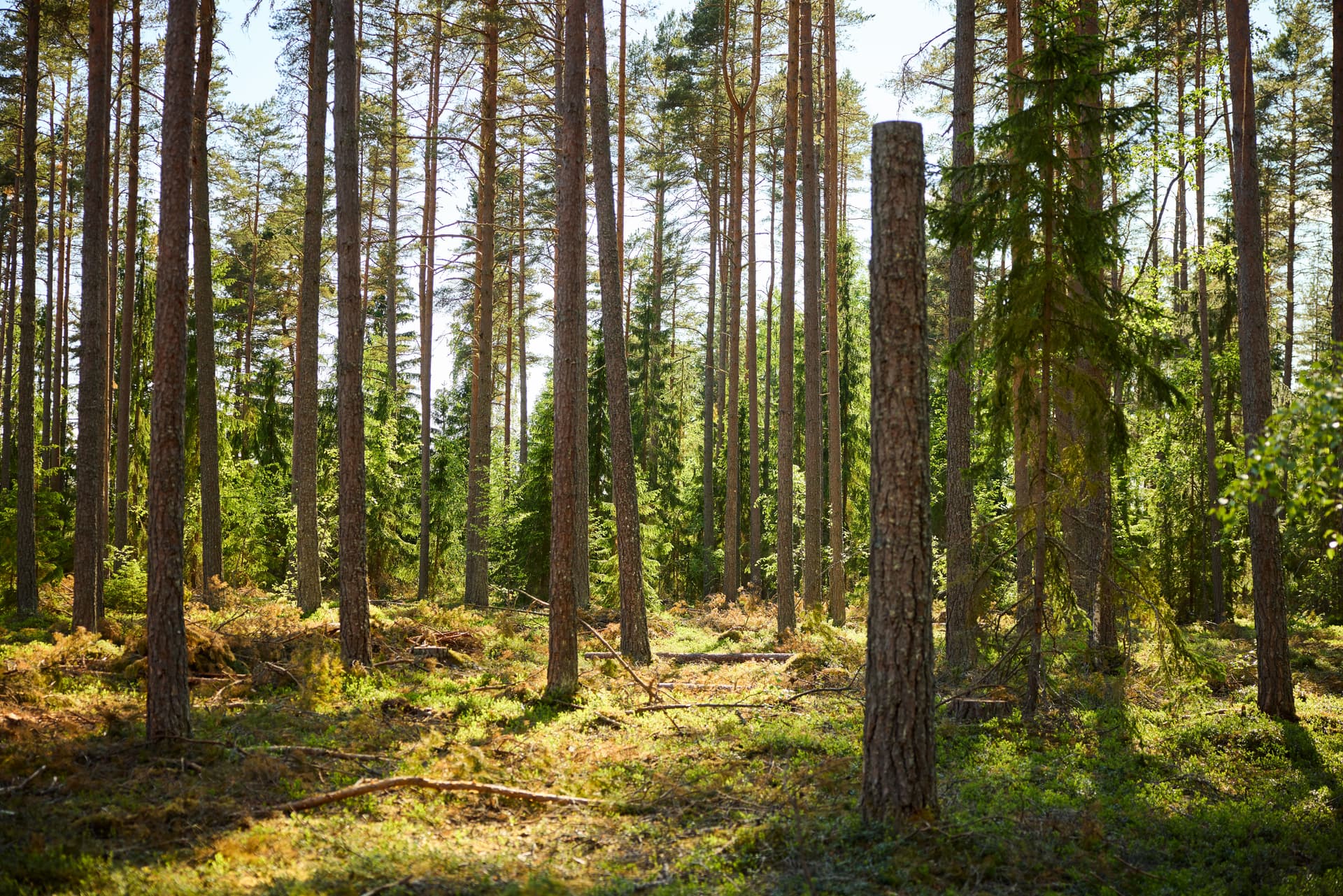
Centered selective cutting is a research-based, continuous-cover harvesting method optimized for value growth in the forest. To explain what’s unique about it, we first need to look at what selective cutting means.
What does selective cutting mean?
Selective cutting (plockhuggning) means harvesting trees selectively while leaving the majority of trees in the stand. Over time, that can result in a multi-layered forest with varied tree sizes and ages. In other words, “selective cutting” describes the broad mechanics of harvesting, but says less about the specific objectives behind it.
Optimizes value growth
The goal of centered selective cutting is to optimize profitability by choosing the harvest timing for each individual tree. The core idea is to release high-quality mid-sized trees, because they can increase in value quickly if they keep growing—but yield relatively low profitability if harvested at their current size.
Centered selective cutting is therefore a form of crown thinning (höggallring). The most valuable trees above a calculated target diameter are harvested to release smaller trees and maximize value growth across the site.
The optimal target diameter varies from tree to tree. Trees with many competitors grow slowly and should therefore be harvested earlier, while trees that stand more freely can often be left to grow to larger diameters. When an individual tree reduces the total value growth of its local tree group, it’s time to harvest it.
Target diameters and tree selection are research-based and derived from calculations of competition for resources, as well as the forest owner’s required rate of return, current timber prices, species, timber quality, and tree vitality. The calculations start from each individual tree and its nearest neighbors—hence “centered.”
Similarities and differences compared to the Naturkultur method
As mentioned above, centered selective cutting focuses on releasing mid-sized trees that can quickly increase in value. The Naturkultur method instead focuses on making room for trees with high timber quality and healthy crowns so they can grow quickly into larger dimensions. The methods are similar, and both can be adapted to the stand’s conditions and the forest owner’s objectives.
In centered selective cutting, removals are calculated using optimization algorithms. Selection rules for which trees to harvest are derived from extensive calculations and simulations of how trees behave in different situations—then adapted based on current knowledge and research literature.
Centered selective cutting with the Hyggligt concept
At Hyggligt, we’ve developed the Hyggligt concept, which is built around centered selective cutting as the harvesting method. By scanning the forest with drones, we collect detailed information about each tree—its volume, species, and competitive situation. The data is analyzed and the selection algorithm is run to create a harvesting plan consistent with the centered selective cutting methodology. The selected trees and the plan are then visualized for the harvester operator in the machine’s computer/map tool—making it easier to cut the right trees and improve efficiency.
Learn more about the Hyggligt concept and our service for continuous-cover harvesting with selective cutting that we offer to forest owners. For forest managers, we offer digital harvest planning tools, mapping tools and operator support for forestry machines, and digital forest inventory and analysis to optimize selective cutting.
Strong net income for the forest owner from the very first selective harvest
2 min read
FAQ: selective cutting and continuous-cover forestry
6 min read
5 financial benefits of harvesting with continuous-cover forestry—using Hyggligt
4 min read
Transition to continuous-cover forestry
3 min read