Will an old forest rot if it’s left alone?
What happens to a forest that’s left to develop freely—i.e., “just left standing”—comes up in many forestry discussions. Does the risk of trees dying increase as a stand gets older? The question is complex and doesn’t have a single answer. How a forest develops depends on the starting conditions.
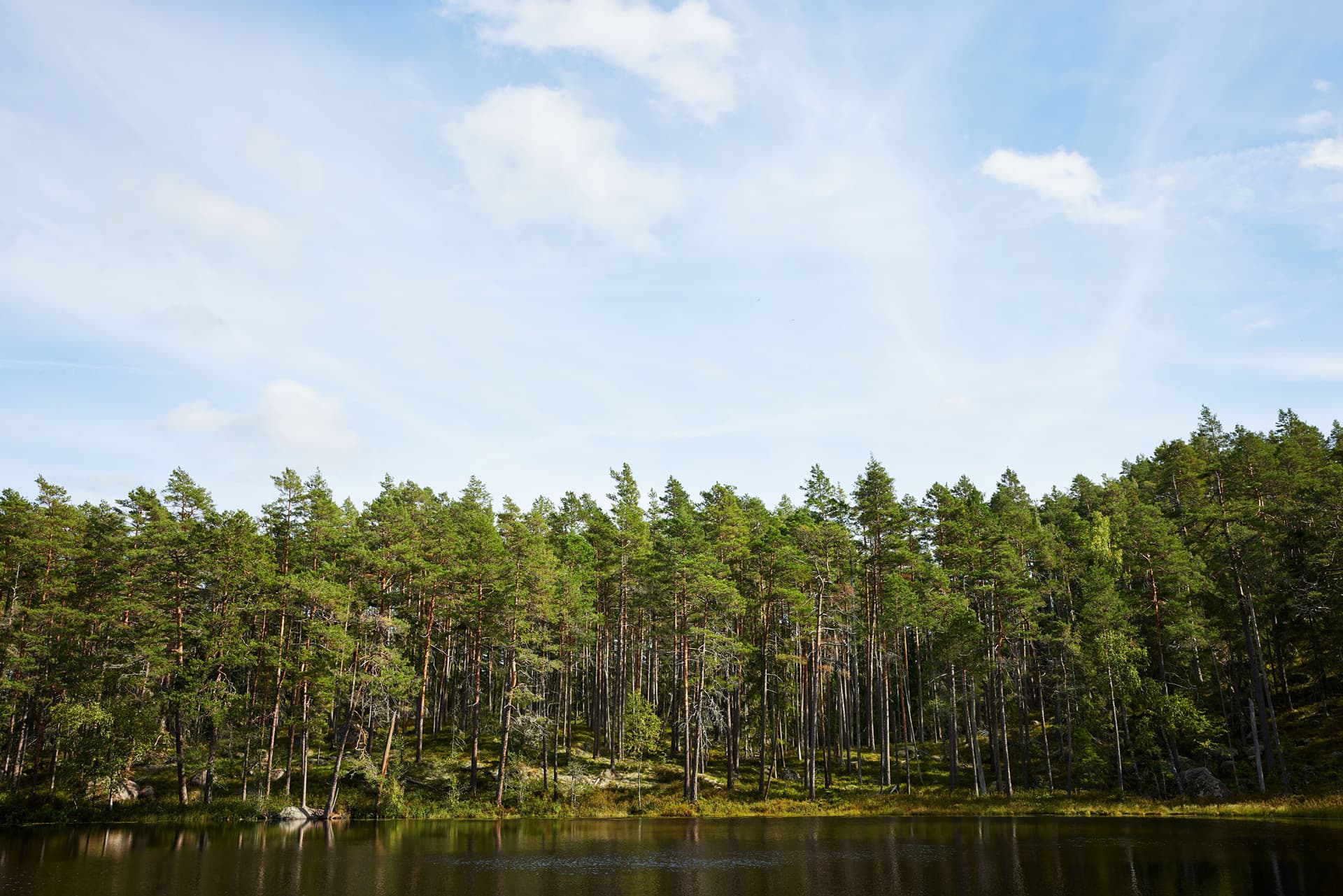
Different forests develop differently
A mixed forest left to develop freely will evolve differently than a spruce monoculture, and a pine monoculture will end up with a different structure than a broadleaf forest. In addition to species composition, the forest’s age and density at the time it is left alone also matter. In dense planted forests, so-called self-thinning (självgallring) will occur: some trees die while others survive and take advantage of newly available growth resources (nutrients, water, and light).
In mixed forests, the dynamics are different. Structurally, mixed stands tend to resemble more natural, unmanaged forests. Gaps form as trees die naturally and because different trees occupy different amounts of space. Trees also live for different lengths of time. A tree’s lifespan depends both on the species’ general longevity (for example, oaks often outlive aspens) and on how long the individual survives at that particular site under competition from surrounding trees.
If a forest is left to develop freely today, it will often favor shade-tolerant species such as spruce, beech, and linden. Of course, a species can only benefit if it is already present in the landscape—so in Sweden, it’s most often spruce that gains from free development. One reason shade-tolerant species benefit in today’s “free-growing” forests is the absence of forest fires, which were relatively common on certain sites under natural conditions. Fires created more open forests with higher light availability, allowing light-demanding species—such as pine, birch, and ash—to establish. Gaps also form in forests that don’t burn, but they are often too small for light-demanding species to establish.
Trädens livslängd och förutsättningar
Another aspect of the “will it rot if left standing?” question is how old trees can get. It varies by species, but pine and spruce—now Sweden’s most common commercial species—can reach roughly 400 and 500 years, respectively, and even older individuals have been found. Trees reaching those ages isn’t very common on fertile sites, but on poorer sites it’s not unusual. What’s clear is that most trees never reach their maximum age: the average age at final felling (slutavverkning) today ranges from 99 years nationwide to 82 years in Götaland. More than half of Sweden’s forests are under 60 years old, while 8% of managed forest is old forest.
Skadegörare
Pests can limit a tree’s lifespan and thereby affect forest dynamics. For example, spruce (especially older individuals) can be attacked by bark beetles. When a group of spruces dies and leaves a gap, new trees can establish. Depending, among other things, on the gap size, spruce may re-establish—or other, more light-demanding species. Fungal infections can drive similar processes.
Fri utveckling jämfört med planerad skogsskötsel
In short, you can’t say with certainty how a forest will develop if it is left untouched—but what is certain is that forests are dynamic and can sustain themselves. If a forest owner is seeking predictability—for example, wanting to know how much return a forest might generate—then active management becomes important.
Active forestry without clearcuts
Forest management aims, among other things, to create predictability—so a forest owner can understand what the forest can provide in terms of ecosystem services such as timber, biodiversity, recreation, and conditions for berry and mushroom picking. Hyggligt’s method—centered selective cutting (centrerad plockhuggning)—steers the forest toward a fully multi-layered structure while keeping standing volume at a relatively steady level.
Hyggligt’s optimization algorithm is the result of extensive simulations that include financial calculations hundreds of years into the future and millions of different tree-selection scenarios. A key part of that optimization is ensuring that the forest’s layered structure is maintained—so management can generate optimal income over long time horizons.
If you want to manage your forest without clearcuts, centered selective cutting with Hyggligt’s model is a long-term alternative. Learn more about continuous-cover harvesting with Hyggligt or go to Calculate your forest and enter your details—we’ll get back to you with an estimate of what it could mean financially.
References
Niklasson, M. & Nilsson, S. (2004) Skogsdynamik och arters bevarande. Studentlitteratur.
SLU Riksskogstaxeringen 2023