Climate impact
Thanks to photosynthesis, trees can be part of the solution to climate change. Globally there are about 3 trillion trees, and together they absorb 2.4 gigatons of CO₂. Global emissions are around 9.4 gigatons of CO₂, meaning the world’s forests absorb roughly 25% of emissions. But the carbon stock in forests must increase, while forests also need to produce renewable materials that replace fossil-based materials—where continuous-cover forestry (hyggesfritt skogsbruk) can play an important role in balancing the two.
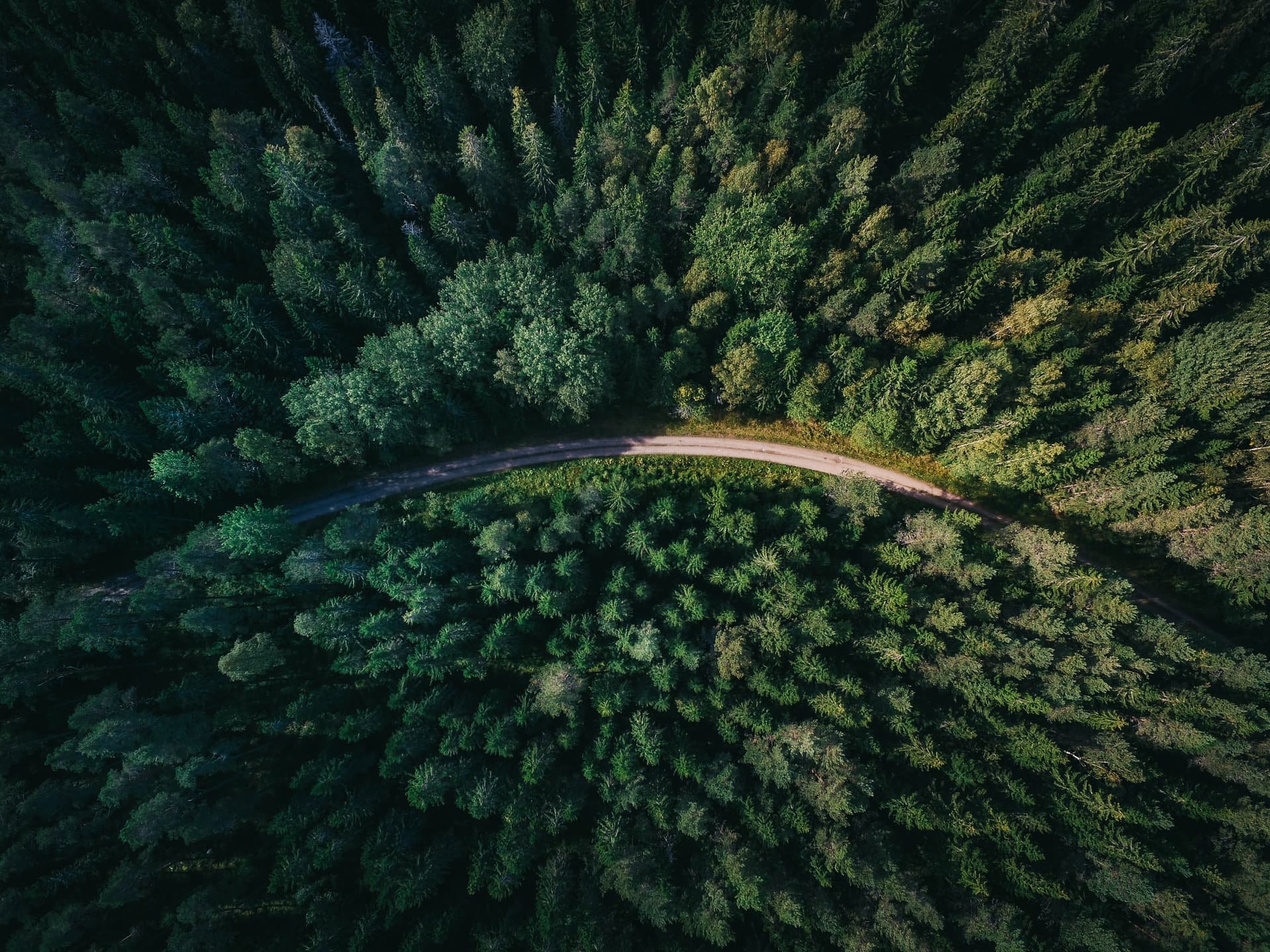
When a forest stand is harvested using traditional clearcut forestry (kalhyggesbruk), there is a net outflow of CO₂, and the clearcut continues to be a carbon source for decades.[1] With continuous-cover forestry (hyggesfritt skogsbruk), the forest can instead remain a carbon sink even immediately after harvesting, because there is still a tree layer that preserves soil structure and keeps photosynthesis going. That’s because a forest’s ability to store greenhouse gases depends both on its standing volume (built through photosynthesis, which has absorbed CO₂) and on the soil’s ability to retain the carbon that has been stored there since the Ice Age.[2]
The time we have to reverse course and protect Earth’s climate is only a few decades.[3] That means we must use a resource with as long a planning horizon as forests with the greatest possible focus on near-term climate benefit—so it matters here and now. Much of the forest industry believes the greatest climate benefit comes from maximizing forest growth so that a larger volume can be harvested to replace fossil-based materials—both short-lived products like plastics and long-lived ones like cement.[4] The key ideas behind this view are the substitution effect and the principle that maximizing growth is the most important lever for optimal climate benefit.[2] That may be true over the very long term. But the climate crisis is now so acute that what we do over the next two to three decades will be decisive for humanity’s future. Fundamentally, that means forests—as a natural (though synthetic capture such as CCS will also be needed) sink for greenhouse gases—must both absorb, and especially retain, the greenhouse gases already captured.
Research from multiple directions suggests that clearcut forestry does not provide the greatest climate benefit in the short term, because it becomes a net source of greenhouse gases during the clearcut phase.[1] [5] One reason is that earlier research may have underestimated the role of greenhouse gases other than CO₂ in forest harvesting—for example, methane, a very powerful greenhouse gas, can be released from soils in connection with clearcutting. The Swedish Forest Agency (Skogsstyrelsen)[2] also notes in its work on forest carbon balance that one way to bind more CO₂ in forests is to harvest a smaller volume—an approach that can be effective over a short to medium-term horizon, i.e. roughly 10–30 years. This line of reasoning becomes especially relevant in light of IPCC reports emphasizing that what we do in the coming decades is decisive for whether we can meet the goals of the Paris Agreement.[6]
Net CO₂ uptake in Swedish forests is about 42 million tons of CO₂ per year—i.e., forest absorption minus the roughly 40 million tons of CO₂ that clearcut forestry emits. There is, however, enormous potential to increase uptake. If Sweden were to stop harvesting entirely—and thereby avoid releasing CO₂ from forests—annual uptake would increase by 80 million tons.[7] That would mean a total of 122 million tons of CO₂ per year. That’s a huge potential that today isn’t being realized under clearcut forestry. Instead, Swedish forest CO₂ uptake has been declining sharply since 2013, because growth has decreased while harvesting and natural mortality have increased. The trend of increasing harvest levels (with some variation) has been ongoing since the 1960s. Back then, 59% of Swedish forests were older than 60 years; today that figure is 43%.[6] If this trend continues to 2060, only 30% of Swedish forests will be older than 60 years.
At the same time, there are climate reasons to use forests as a resource—by using forest raw materials to substitute for fossil-based materials.[2] Substitution means replacing materials that would otherwise be produced (e.g., cement) or fuels that would otherwise be burned (e.g., using bioenergy instead of coal/oil) with renewable materials from forests. If forests are managed so that growth continuously exceeds removals—and managed with continuous cover so emissions from clearcuts are avoided—the substitution effect can further increase the forest’s climate benefit. Crucially, however, the extracted raw material must actually replace fossil materials, and not be used to meet entirely new demand—because then it doesn’t substitute for fossil inputs. The safest form of substitution is therefore replacing long-lived products like cement with timber, since short-lived products like paper risk being burned and returning CO₂ to the atmosphere.
Continuous-cover forestry means a larger share of the harvested volume becomes long-lived products, because the sawlog share is substantially higher.[8] Together with keeping the land continuously tree-covered, this makes continuous-cover forestry the management approach that best captures the forest’s potential climate benefit. Add the growth gains enabled by Hyggligt’s optimization for continuous-cover forestry, and the climate benefit increases even further—so much so that Swedish forests could, in theory, offset all of Sweden’s greenhouse gas emissions and even a share of other countries’ emissions.
References
Vestin, P. (2017) Effects of forest management on greenhouse gas fluxes in a boreal forest. Lunds universitet.
Skogsstyrelsen (2020) Skogsskötselserien kapitel 21 - skogens kolbalans och klimatet.
IPCC (2022) Report: Mitigation of climate change.
Stora Enso (2023) Why do we focus on climate.
Stokland (2021) Volume increment and carbon dynamics in boreal forest when extending the rotation length towards biologically old stands. Forest Ecology and Management, 2021. doi.org/10.1016/j.foreco.2021.119017.
WWF 2023 wwf.se/klimat/klarar-vi-klimatmalen/.
Holm i Forskning och framsteg 2021 fof.se/artikel/skilj-pa-skogen-och-skogsindustrin/.
Fagerberg, N. Kontinuitetsskogsbruk.se.