Biodiversity
Continuous-cover forestry (hyggesfritt skogsbruk) is, in every way, substantially better for biodiversity than traditional management methods.
The term biodiversity has become widely used in recent years—but what does it mean, and what does it specifically mean in a forestry context?
The broad definition is “the variety among living organisms, including variation within species, between species, and across ecosystems.”[1] The reason the term has become so prominent is that research shows biodiversity is declining in most habitats around the world. In Sweden, there are 4,746 red-listed species (rödlistade arter) across all habitats. Swedish forests are no exception, and the situation is extremely serious: during the 20th century—i.e., during the era when clearcut forestry (kalhyggesbruket) has been practiced—we reduced populations of roughly 1,000 forest-dwelling species to such an extent that they are now red-listed.[2] A red listing means a species can range from near threatened to nationally extinct. Research suggests that at least about 400 of these declines can be linked directly to clearcut areas (kalhyggen), while others may be influenced by a combination of factors in which clearcut forestry is one of them.
Sweden has fifteen different forest types, but only mountain birch forest (fjällbjörkskog) has a favorable conservation status. Mountain birch forest has no commercial value for forestry.[1]
The main reason biodiversity is trending downward in Swedish forests is that many species depend on forest continuity (skoglig kontinuitet)—meaning they do best when the land remains continuously tree-covered. Clearcut forestry can never provide that continuity, because all trees are removed once per rotation period (omloppstid), which varies from north to south between 70 and 130 years. Research shows it takes much longer than 100 years for a forest to develop the complex ecosystems that best support biodiversity. In addition to the disturbance of removing all trees at once, after a clearcut it’s common to replant only a single tree species. That creates a monoculture: species-poor, uniform, and unstable ecosystems that are highly sensitive to pests and storms, for example.
Compared internationally, Sweden has very little formally protected forest: only 6%, and an additional 5% consists of voluntarily set-aside areas. The reason Sweden stands out is that the 1993 Forestry Act (skogsvårdslag) aimed to combine forest use with nature conservation. The law states that production goals and environmental goals should carry equal weight, and that forestry should be guided by “freedom with responsibility” (frihet under ansvar). The intention was to preserve biodiversity through general consideration in all forestry—rather than dividing land into protected area and managed area, as is done in places like New Zealand and Australia.[3] In practice, however, this has not worked—partly due to insufficient guidance on how to balance production and environmental goals, and partly due to clearcut forestry itself.
If you look more closely at where the formally protected area is located, you find that 40% lies in or near the mountain range. That means mountain habitats are overrepresented among protected areas, while many of our other habitats are heavily underrepresented.[1] As a result, there is very little old-growth/natural forest with high biodiversity across the rest of Sweden. These areas are small and highly fragmented, which threatens biodiversity even within protected areas because they become especially vulnerable to random disturbances such as forest fires.
The 5% mentioned above that consists of voluntary set-asides can always be switched by the landowner to production-oriented management and clearcut—even if that results in the owner losing certification. In a forest management plan, this kind of land is often classified as “nature conservation, untouched” (naturvårdsmål orört, NO) or “nature conservation, with management” (naturvårdsmål med skötsel, NS), and can—for example upon a change of ownership—be reclassified as a production goal (produktionsmål, PG). In managed forests (production goal), so-called retention patches (hänsynsytor) are often left, but research shows these areas are too small.[4] One study found that a 0.5-hectare retention patch is too small—and for comparison, in private forestry the average retention patch is 0.16 hectares. Today there are major conflicts in the forest between those who want to preserve forests and those who want to manage them for production. There are, however, examples where more diversified forestry has reduced these conflicts—one is Lower Saxony (Niedersachsen) in Germany, which has adopted a multifunctionality approach to forests.[3]
At Hyggligt, we believe a transition to continuous-cover forestry could ease these conflicts, because environmental goals and production goals can go hand in hand in continuous-cover management. We say that because a forest managed without clearcutting maintains continuity, develops a natural mix of species and natural regeneration (naturlig föryngring), and still provides returns. These three factors make continuous-cover forestry substantially better for biodiversity—while still delivering strong returns, in many cases even better than clearcut forestry.
Research shows that many of the species that are red-listed today due to clearcut forestry would do much better under a more diverse continuous-cover approach.[5] A Finnish study found that species diversity increased substantially under continuous-cover management.[5] Historically, Swedish forests were also managed using a wider range of methods—at least in private forestry—but today more and more forest owners rely on timber buyers and inspectors from forestry companies for management decisions, which tends to prioritize volume production via clearcut forestry above all else.
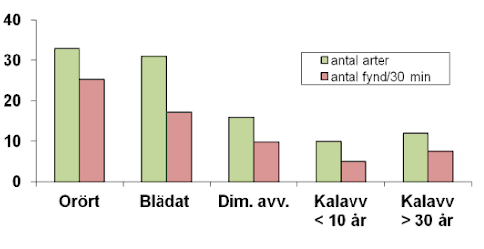
Fig. 1. Excerpt from a study comparing forests managed with the continuous-cover method “selection system” (blädning) versus forests managed with clearcutting, focusing on the presence of indicator species tied to conservation value (naturvärdesarter). The red bar shows the number of such species found within 30 minutes, while the green bar shows the total number found.
Biodiversity has great intrinsic value, of course—but it can also be valued economically. In a changing climate, forests with high biodiversity are far more likely to withstand climate impacts than uniform monocultures.[1] This is often described as forest resilience (resiliens), and it’s becoming increasingly relevant. The natural regeneration that follows continuous-cover management creates greater genetic diversity, which gives forests a better chance of surviving drought, pest outbreaks, and other disturbances. The major economic losses forest owners face today due to spruce bark beetle attacks could be reduced if forests contained more species than just Norway spruce.[6]
Trees live together with—and depend for growth on—soil fungi known as mycorrhiza (mykhorriza); this partnership is a form of symbiosis (symbios). Trees and fungi benefit each other: tree roots receive nutrients and water, while fungi receive carbohydrates.[1] The disturbance created by a clearcut knocks out these soil fungi, and with them the ability to help trees access, among other things, water.[7] After a clearcut, it takes a very long time for soil fungi to reestablish—nearly 100 years—and then it’s time for final felling (slutavverkning) again. Climate change is happening at a very rapid pace, meaning trees need to adapt faster than ever before. Trees have existed for at least 200 million years and have always adapted to changing climates—but never before have changes happened as quickly as they are today. Trees will need every advantage they can get, making the role of soil fungi as transporters of water and nutrients even more important. It’s unlikely that trees can adapt both to climate change and to repeated disturbances from clearcut forestry.
Connectivity (konnektivitet) is another concept that’s becoming increasingly important in biodiversity discussions. It relates to what we mentioned earlier about Sweden’s fragmented natural forests below the mountains. These natural forest areas need to be connected, and continuous-cover forestry can play a decisive role—because such forests can also support more demanding species that are wiped out under clearcut forestry.
In short, continuous-cover forestry will play a decisive role both in preserving biodiversity for its own sake—and in preserving biodiversity so that we can continue practicing forestry in the future.
References
Världsnaturfonden (WWF) (2020) Skogsrapport.
Ottosson, E. Skogliga arter som hotas av modernt skogsbruk. SLU - artdatabanken.
KSLA Kungliga Skogs- och Lantbruksakademiens (2017) Tidskrift nr. 1.
Gustafsson, L., Hannerz, M., Koivula, M., Shorohova, E., Vanha-Majamaa, I., and Weslien, J. (2020). Research on retention forestry in Northern Europe. Ecological Processes 9, 3.
Pukkala, T., Packalen, O. Díaz-Yáñez*, T. and H. Peltola (2019) Multifunctional comparison of different management strategies in boreal forests. Forestry: An International Journal of Forest Research, Volume 93, Issue 1.
Lindmark, M. (2022) Increased resilience in managed boreal forests: Controlling damage by spruce bark beetle and moose in Sweden. Mittuniversitet.
Skogsstyrelsen (2011) Kontinuitetsskogar och hyggesfritt skogsbruk. Rapport 7 2011.